
Type a question into ChatGPT, Perplexity, or Google’s AI Mode today, and you won’t get ten blue links to sort through. You’ll get one answer, written in plain language, with maybe two or three sources quietly cited at the bottom. That’s the entire search experience now for a growing share of queries, and it changes what “ranking well” actually means.
Most articles on this topic repeat the same surface-level definition of AEO without explaining what’s actually happening inside the system when it decides what to cite. This guide goes further. We’ll walk through the real mechanics of how AI search retrieves and selects content, what separates a page that gets cited from one that gets ignored, and a practical checklist you can apply today, whether you’re already ranking well in Google or starting from zero.
What Is AEO (Answer Engine Optimization)?
AEO, or Answer Engine Optimization, is the practice of structuring, writing, and technically preparing content so that AI systems can accurately retrieve it, understand it, and cite it inside a generated answer.
Where traditional SEO measures success by rankings and clicks, AEO measures success by a different set of outcomes: how often your content gets cited, how accurately an AI tool represents your brand or information, and how visible you are inside a conversational answer that the searcher may never click through from at all.
AEO isn’t a replacement for SEO. It’s built directly on top of it. AI answer engines still rely on the same underlying web infrastructure that traditional search engines use: crawlable pages, indexed content, and trust signals like backlinks. A site with weak technical SEO will struggle in AI search for the same basic reason it struggles in Google: if a crawler can’t reliably access and parse the page, nothing downstream matters.
How AI Search Actually Retrieves and Cites Content
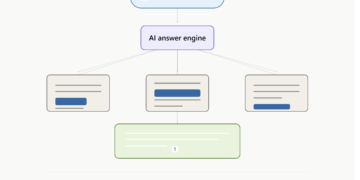
To optimize for AI search, it helps to understand what’s happening mechanically, not just conceptually. Most AI answer engines follow a process built on a technique called retrieval-augmented generation, or RAG. Here’s how it actually works, step by step.
Step 1: Query Interpretation and Expansion
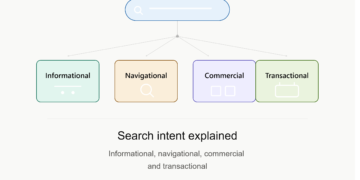
When you ask an AI system a question, the model first has to work out your actual intent, which is often broader than the literal words you typed. Many systems then perform what’s called query fan-out: breaking one question into several related sub-questions to cover more angles. A question like “best budget laptop for a student” might quietly expand into sub-searches covering price ranges, battery life, and specific brand comparisons, each retrieved separately before being merged into one answer.
Step 2: Chunking, Not Whole Pages
This is the part most SEO content skips over, and it’s arguably the most important mechanical difference from traditional search. AI systems don’t retrieve entire web pages. They retrieve small chunks of text, typically a paragraph or a few sentences, that have been broken apart and stored as searchable units ahead of time.
This means your page isn’t competing as a whole document. Each section or paragraph is competing on its own to be the single best chunk that answers a specific sub-question. A page can have nine mediocre paragraphs and one exceptional, self-contained paragraph, and that one paragraph is what gets pulled and cited, regardless of how the rest of the page reads.
Step 3: Semantic Retrieval by Meaning, Not Keywords
Instead of matching your exact search words, the system compares the meaning of your query against the meaning of millions of stored content chunks, using a mathematical representation called an embedding. This is why an AI answer can pull a passage that never uses your exact search terms but clearly addresses the same underlying question. Keyword matching still matters for traditional crawlability and indexing, but at the retrieval stage, meaning matters more than phrasing.
Step 4: Ranking Retrieved Chunks by Trust and Relevance
Once the system has a shortlist of candidate chunks, it ranks them using a mix of relevance to the query and trust signals about the source: the domain’s authority, how consistently the site publishes accurate information, whether other trusted sources corroborate the same claim, and how recently the content was verified or updated.
Step 5: Synthesis and Citation
Finally, the model composes a natural-language answer using the retrieved chunks, weaving them together into a coherent response and citing a small number of sources, usually far fewer than the number of chunks it actually pulled from during retrieval.
The practical takeaway from all five steps: you’re not optimizing a page anymore. You’re optimizing individual, self-contained passages that need to survive being extracted from their original context and still make complete sense.
How AEO Is Different From Traditional SEO
| Traditional SEO | AEO | |
|---|---|---|
| Unit being evaluated | The whole page | Individual passages or chunks |
| Matching method | Keywords plus relevance signals | Semantic meaning (embeddings) |
| Success metric | Ranking position, clicks, organic traffic | Citation frequency, accurate mention, share of answer |
| Ideal content shape | Long-form, comprehensive, internally linked | Short, direct, self-contained answers within a comprehensive page |
| Authority signal | Backlink quantity and quality | Corroboration across multiple independent trusted sources |
| Outcome for the searcher | A click to your website | Often a zero-click answer, with your brand mentioned |
The two disciplines overlap heavily. A page built with strong technical SEO, real expertise, and clear structure is already most of the way to being AEO-ready. AEO simply adds a final layer of precision on top.
A Practical AEO Checklist
1. Answer the exact question in the first two to three sentences
Every major section should open with a direct, complete answer to the question implied by its heading, before expanding into detail. If the answer is buried under three paragraphs of introduction, most retrieval systems will skip past it in favor of a competitor’s more direct passage.
2. Write section headings as real questions
Headings like “What is X?” or “How does X work?” match almost word-for-word against how people phrase questions to AI tools, which makes retrieval easier and more accurate.
3. Make each passage self-contained
Read each paragraph in isolation, as if it were the only thing an AI tool pulled from your entire page. Does it still make complete sense without the surrounding context? If a paragraph depends on “as mentioned above” or an unexplained pronoun, rewrite it so it stands alone.
4. Use structured data (schema markup)
FAQ schema, Article schema, and How-To schema give AI crawlers an explicit, machine-readable map of your content’s structure and meaning, reducing the chance of misinterpretation during retrieval.
5. State facts plainly, and keep them current
AI systems are cautious about citing information that looks outdated or that conflicts with other sources. A page with a clear “last updated” date, current statistics, and consistent facts across your own site is more likely to be trusted during the ranking step.
6. Build corroborated authority, not just backlinks
Traditional SEO rewards a link from one authoritative site. AEO rewards a claim that shows up consistently across several independent, trusted sources: an original data point that other sites cite, a definition that stays stable across multiple credible domains, an expert quote that gets referenced elsewhere. This corroboration is what a trust-ranking step is specifically checking for.
7. Keep your technical SEO foundation solid
Fast load times, clean crawlability, mobile responsiveness, and unblocked indexing remain the entry ticket. AI crawlers, like Google’s own crawlers, simply move on from a site that’s slow or difficult to access.
How to Measure AEO Performance
Traditional analytics were never built to track this, so measurement takes a slightly different shape:
- Manually test your target questions. Ask ChatGPT, Perplexity, and Google’s AI Mode the exact questions your content is meant to answer, and note whether your brand or page gets mentioned and cited.
- Check AI referral traffic in your analytics. Most modern analytics tools now separate AI-driven referral traffic (from ChatGPT, Perplexity, and similar) into its own channel, letting you track it distinctly from organic search.
- Watch Google Search Console’s AI-related reporting. Google has started surfacing how content performs specifically within AI Overviews and AI Mode, separate from standard organic performance.
- Track share of answer, not just rankings. For a set of important questions in your niche, periodically check how often your brand appears in the generated answer relative to competitors. This is a newer, less standardized metric, but it’s the closest AEO equivalent to a keyword ranking.
Common AEO Mistakes
- Writing long introductions before the actual answer. If the direct answer doesn’t appear until paragraph four, most AI systems will find and cite a competitor’s more direct passage instead.
- Treating AEO as a separate strategy from SEO. Trying to run AEO without a solid technical and content SEO foundation underneath it rarely works, because both disciplines depend on the same crawlability and trust signals.
- Chasing volume of backlinks instead of corroborated accuracy. A single unique, well-corroborated fact often earns more AI citations than a dozen generic backlinks pointing at thin content.
- Ignoring content freshness. Stale statistics or outdated claims quietly get passed over during the trust-ranking step, even if the page still ranks fine in traditional search.
- Writing exclusively for machines and losing the human reader. Content that reads like a checklist with no voice or context tends to underperform for actual visitors, even if it’s technically well-structured for extraction. The strongest AEO content is written for a human first, and structured for machines second.
Frequently Asked Questions
What does AEO stand for?
AEO stands for Answer Engine Optimization, the practice of structuring and preparing content so AI systems like ChatGPT, Perplexity, and Google’s AI Overviews can accurately retrieve, understand, and cite it in a generated answer.
Is AEO the same as SEO?
No, but they’re closely related. SEO focuses on ranking full pages in search results and earning clicks. AEO focuses on getting individual passages of content retrieved, trusted, and cited inside AI-generated answers, which often happens without a click at all. AEO is best understood as an extension of SEO, not a separate discipline.
How do AI search engines decide what to cite?
Most AI search tools break web content into small, searchable passages, match those passages to a query by meaning rather than exact keywords, rank the strongest matches by relevance and trust signals, and then compose an answer that cites a small number of the most reliable sources.
Do I need backlinks for AEO?
Backlinks still help, since they remain a core trust signal for both traditional SEO and AI systems. But AEO places extra weight on corroboration: whether the same fact or claim appears consistently across multiple independent, trusted sources, not just how many links point at your page.
How can I check if my content is being cited by AI tools?
Manually search your target questions inside ChatGPT, Perplexity, and Google’s AI Mode to see whether your brand appears. Alongside that, check your analytics platform for AI-driven referral traffic and review any AI-specific reporting available inside Google Search Console.